
Welcome to Neuroptima
At Neuroptima we aim to de-stigmatise the general attitudes towards mental health and well-being.
Our trained professionals guide you through the neurofeedback process, helping you develop strategies to optimize your cognitive abilities. With consistent practice, you can strengthen neural connections, enhance brain coherence, and unlock your full potential. We also offer Deep Brain Reorienting sessions.
Help your brain achieve greater stability, flexibility and be able to self-regulate so you can experience life in a more balanced way and improve your brain functioning.

‘We live in an increasingly fast-paced world with competing demands and a sense of constant urgency that pulls for our attention. Some of us faced ruptures in our attachments with significant care givers due to loss, neglect, abuse, bereavement, physically or emotionally absent parenting which impacted on our resilience and the way we perceive the world around us. Some of us are born neurodivergent and the way our brain is wired makes us feel, see and understand the world in a remarkably different way than our neurotypical peers. Most of us live with daily stressors (at home, at work/school, in the community), and some of us face repeated setbacks and traumatic events that test and, over time, weaken our capacity to bounce back. It is no wonder that symptoms of anxiety, depression, panic, PTSD, insomnia, headaches, IBS, weakened immune system, emerge.
Life improves when we can experience these feelings without significant state disruption, when we feel them as just feelings and not triggers. When this happens, these feelings lose their disruptive power. We can acknowledge them, feel and appreciate them without being hijacked by them and we can move on from them’.
Director Neuroptima


Ready to optimize your brain's potential?
Tailored to your unique needs, our sessions focus on improving self-regulation and achieving optimal balance.
What is Neurofeedback?
Neurofeedback is a type of biofeedback that uses real time monitoring of brain activity to teach self-regulation of brain function through training. It is also known as EEG biofeedback, as it typically involves monitoring the electrical activity of the brain using electroencephalography (EEG). It provides the brain with feedback to help create new pathways, new brainwave activity and stimulate increased flexibility within the brain.
By feeding back information on its own regulatory network using an enjoyable audio/visual/tactile stimulus, such as a preferred movie or a video game, the brain and nervous system can learn better regulation. Neurofeedback does not provide a cure. It trains the brain and the nervous system towards learning to self-regulate better.


What is Deep Brain Reorienting (DBR)?
Deep Brain Reorienting (DBR) focuses on the brainstem-level
neurophysiological processes activated during traumatic events.
It is the combination of these top down and bottom-up approaches that makes
these two modalities work very well together.
DBR is a neurobiologically-informed approach that focuses on the brain’s subcortical regions, particularly the brain steam and the midbrain. These ancient parts of our brain are responsible for our most basic survival instincts, including our orienting responses to potential threats.
When trauma occurs, these instinctual responses can become stuck or dysregulated, leading to a host of symptoms that can last for years, even decades. Deep Brain Reorienting aims to guide the client towards noticing what happens in their bodies in each sequence of the traumatic event, creating the space and allowing the brain to process and integrate traumatic experiences in a way that traditional talk therapies often struggle to achieve.
How do Neurofeedback and DBR work?
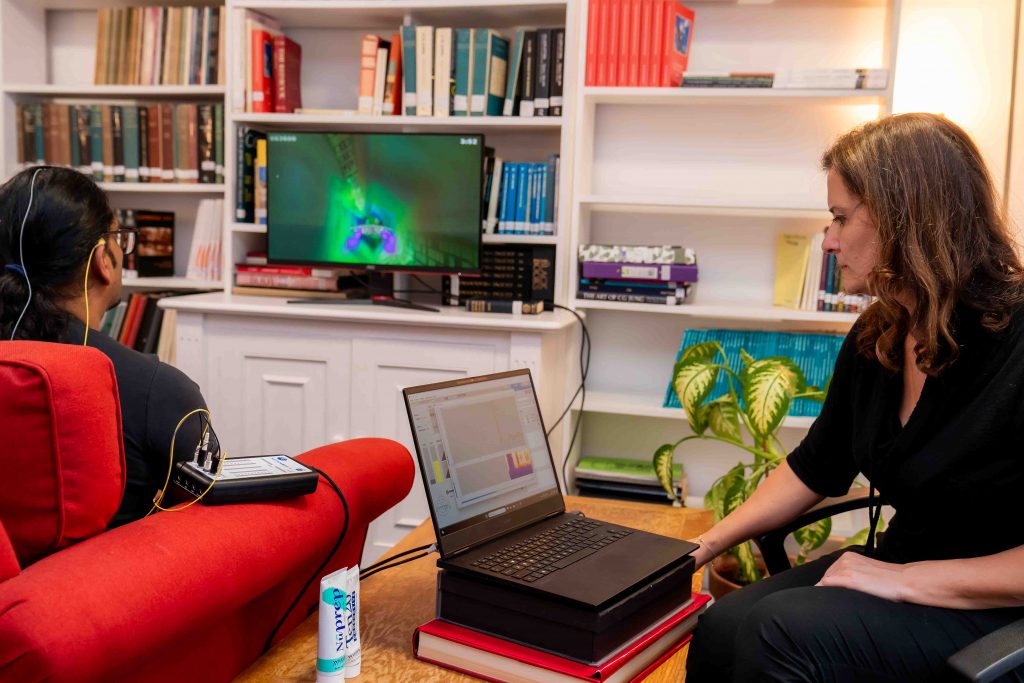
In a neurofeedback session, you sit comfortably in a chair and watch a movie or play a game. Based on the symptoms you are struggling with the practitioner will know where to place electrodes on your head so that we are able to measure your brain’s electrical activity in real time. The software interprets the brain wave activity and uses a positive reward system that modulates the stimulus, adjusting its brightness, darkness and volume in accordance with brain activity. In simple terms, the game or movie will play when your brain approaches a more efficient state of activity and will stop or the image on the screen will shrink or get out of focus, or the sound will be louder or softer when the electrical activity indicates an imbalance or inefficiency. As such, through neurofeedback training, you learn to modify your brainwave patterns to improve cognitive function, emotional regulation and overall well-being (Sebern Fisher, 2014).
In DBR the client is methodically and supportively guided to track the original sequence of physiological responses that occurred when the beep brain had been alerted to a threat or an attachment disruption, leading to the release of the traumatic shock and a reduction in trauma related cognitive distortions, symptoms and reactions. DBR is also successfully delivered online.
